
Progressive Lenses in San Francisco
See distance, computer range and reading areas through one pair of glasses without visible bifocal lines. Clear Vision Optical provides in-person progressive lens measurements, frame evaluation and design guidance.
- ✓ In-person measurements
- ✓ Standard and advanced designs
- ✓ Existing frames evaluated
What Are Progressive Lenses?
Progressive lenses are multifocal prescription lenses with a gradual change in power from the upper area of the lens to the lower area.
Instead of separating distance and reading correction with a visible bifocal line, progressive lenses place multiple viewing areas within one continuous lens design.
The available viewing areas and how they feel depend on the lens design, prescription, frame, measurements and the way the glasses sit on your face.
Progressive Lenses May Be Considered If You:
- Need both distance and reading correction
- Use computers or screens during the day
- Want one pair for multiple viewing ranges
- Prefer lenses without visible bifocal lines
- Need help comparing progressive designs
How Progressive Lens Viewing Areas Work
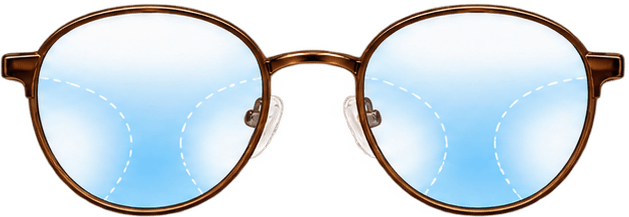
The lens power changes gradually between the upper, middle and lower portions of the lens.
Distance Area
The upper portion is primarily used for farther viewing, including many outdoor, driving and room-distance tasks.
Intermediate Area
The middle portion supports intermediate distances, including many computer, dashboard and indoor tasks.
Near Area
The lower portion is used for reading, phones and other activities performed at closer viewing distances.
Your Daily Activities Should Guide the Lens Choice
Not every progressive wearer uses distance, computer and reading vision in the same way. Your daily routine helps determine which viewing areas matter most.
Driving and Outdoor Vision
Tell us how often you drive, walk outdoors, attend events or rely on clear distance viewing.
Computer and Screen Use
Desktop monitors, laptops and workstations may place more importance on the intermediate viewing area.
Reading and Phone Use
Reading habits, phone use and close work help define how much near vision is used during a typical day.
Balanced Everyday Use
Many wearers need a practical balance between distance, computer and near viewing rather than one dominant area.
Why Progressive Lens Measurements Matter
The different prescription areas must be positioned according to your eyes and the way the selected frame sits.
| Measurement or Fit Factor | Why It Matters | How It Is Evaluated |
|---|---|---|
| Pupillary distance | Helps position the lenses according to the horizontal location of your eyes. | Measured in person |
| Fitting height | Helps position the progressive design vertically within the selected frame. | Frame must be worn |
| Frame depth and shape | Influences the space available for the progressive corridor and viewing areas. | Frame evaluated |
| Frame alignment | A crooked or unstable frame can change where the viewing areas sit in front of the eyes. | Fit checked first |
| Pantoscopic tilt | The angle of the frame may be relevant to lens position and certain design calculations. | Checked when relevant |
| Vertex distance | The distance between the lens and the eye may be relevant for some prescriptions and designs. | Checked when relevant |
The exact measurements required depend on the prescription, selected progressive product, frame and fitting situation.
Standard and Advanced Progressive Lens Designs
Progressive products vary in usable viewing areas, corridor characteristics, peripheral behavior and available customization.
Standard Progressive Lenses
Standard progressive lenses provide distance, intermediate and near prescription areas through a general lens design.
- Multiple viewing ranges in one lens
- No visible bifocal line
- General corridor and viewing-area design
- Performance varies by product
- May suit many routine visual needs
Advanced or Customized Progressives
More advanced progressive designs may offer additional personalization or different balances between usable viewing areas.
- Additional design customization may be available
- Viewing-area balance varies by product
- May use more frame or fitting information
- Useful for specific visual priorities
- Not automatically necessary for every wearer
Why Corridor Length Matters
The corridor is the area through which the prescription changes gradually from distance to intermediate and near vision.
Corridor selection depends on the frame depth, prescription, fitting measurements, lens design and how the glasses will be used.
- Smaller frames may require shorter designs
- Deeper frames may allow other corridor options
- Different designs balance viewing areas differently
- The frame should be evaluated before ordering
The Frame Is Part of the Lens System
Progressive performance is influenced by the space available in the frame and how securely the frame holds its position on your face.
- Sufficient vertical lens depth
- Stable bridge and nose-pad position
- Frame that remains properly aligned
- Appropriate size and shape
- Compatibility with the selected lens design
Choosing a Progressive Lens Material
Material selection depends on prescription, frame, lens dimensions, desired thickness, impact-resistance priorities and budget.
Polycarbonate
Polycarbonate is a lightweight, impact-resistant material that may be considered when durability is a priority.
1.60 High-Index
A 1.60 material may provide a useful balance of thickness, weight and optical characteristics for some prescriptions.
1.67 High-Index
A 1.67 material may help reduce thickness for some stronger prescriptions, depending on the frame and full prescription.
Can Progressive Lenses Go Into Existing Frames?
Progressive lenses can often be installed in existing frames when the frame is structurally sound and suitable for the selected progressive design.
Existing-frame compatibility cannot be determined from the frame brand alone. The actual frame depth, fit, condition and ability to hold an adjustment must be reviewed.
View Lens Replacement Service Buy Progressive Lenses →We Check Whether the Frame:
- Is structurally sound
- Has sufficient vertical lens depth
- Holds its adjustment properly
- Allows accurate fitting measurements
- Fits securely on your face
- Works with the selected progressive design
Adapting to Progressive Lenses
Adaptation time varies. Some wearers adjust quickly, while others need additional time to learn how to use the different viewing areas.
Wear the Glasses Consistently
Regular use may help you become more familiar with moving between the distance, intermediate and near areas.
Use the Appropriate Lens Area
Progressive wearers may need to adjust head and eye position when moving between different viewing distances.
Return if Discomfort Continues
If the lenses remain uncomfortable, the frame position, fitting measurements and lens alignment should be checked.
Visit Clear Vision Optical in San Francisco
Bring your prescription, current glasses and preferred frame so we can discuss your distance, computer, reading and everyday visual needs.
We can compare frame suitability, materials and progressive lens designs before your lenses are ordered.
Shop Progressive Lenses Online → ☎ Call (415) 921-3222 Get DirectionsSan Francisco, CA 94115
Why Choose Clear Vision Optical?
Progressive lenses should be selected as a complete system involving prescription, frame, measurements, design and final fitting.
Related Lens and Eyeglass Services
Explore additional services related to progressive lens selection, frame choice and lens replacement.
Progressive Lenses San Francisco FAQ
Common questions about progressive lens designs, measurements, frames and adaptation.
What are progressive lenses?
Progressive lenses are multifocal prescription lenses that provide gradual changes between distance, intermediate and near vision without visible bifocal lines.
How long does it take to adjust to progressive lenses?
Adaptation time varies. Some customers adjust quickly, while others may need more time or a follow-up frame and fitting check.
What is the difference between standard and advanced progressives?
Progressive designs vary in corridor characteristics, usable viewing areas and available customization. The appropriate choice depends on your prescription, frame, visual priorities and budget.
Can progressive lenses go into my existing frames?
Often, yes. The frame must be structurally sound, provide sufficient vertical depth, hold its adjustment and allow accurate fitting measurements.
Do progressive lenses have visible lines?
No. Progressive lenses provide a gradual transition between distance, intermediate and near prescription areas without the visible line found in traditional bifocals.
Why are in-person measurements important?
Progressive viewing areas must be positioned according to your eyes and the way the selected frame sits. Measurements may include pupillary distance, fitting height and frame-position information.
Can progressive lenses be used for computer work?
Progressive lenses include an intermediate viewing area that may support many computer tasks. The most appropriate design depends on working distance, screen use and other daily visual priorities.
What if my progressive lenses remain uncomfortable?
Return to the store so the frame position, fitting measurements, lens alignment and intended use can be reviewed.
Ready for Progressive Lenses?
Shop Progressive prescription lenses online or visit Clear Vision Optical in San Francisco for in-person measurements and help choosing the right lens design for your prescription, frame and daily visual needs.